Showing posts with label Christopher Stiffler. Show all posts

Thursday, September 20, 2012

“Opportunity Costs” Series:

 
Financial Aid Cuts and Consequences
By
Christopher Stiffler
 
One of the most memorable topics discussed in Economics 101 is the idea of opportunity cost.  With a limited amount of resources, a decision to do one activity inevitably results the inability to do another.  Economists calculate opportunity cost by asking the question, “what is the value of the next best alternative that you give up in order to do that activity?” 

Pose the question, “what is the opportunity cost of attending this lecture?” to a bunch of freshmen Economics 101 students at 8 a.m. and the first response is always “sleeping.”

 Pose the question, “what is the opportunity cost of this new cut back in spending?” to a politician and it is difficult to get a straight answer.  This is because the indirect and foregone alternatives are very difficult to quantify.  But like all decisions, there is always an opportunity cost; always a relationship between scarcity and choice.  Cuts to state funding at one end inevitably result in trade-offs somewhere else. 

As Colorado has been cutting state funding to all sorts of programs, it has been difficult to quantify the indirect, downstream consequences.   The Colorado Center on Law and Policy’s goal with our “Opportunity Cost” series is to enumerate exactly what Colorado forgoes as it chooses to be a low-funding state. 

The first of this series investigates the state cuts to higher education.  Due to budget balancing and reduced General Fund revenues, Colorado higher education has seen a 30 percent operating cut since 2009.[1]  This means fewer dollars sent directly to Colorado institutions and fewer dollars available for Colorado students in the form of state financial aid.  To compensate for lower state funding, Colorado colleges and universities were granted the ability to raise tuition.  As a result, a new college tuition model began to emerge.  In the new model, wealthier students pay the higher tuition, which is then redistributed in the form of institutional aid to lower income students. 

Recent research about price sensitivity of Colorado college students shows that low-income students are much more sensitive to tuition increases than higher-income folk.[2]  In fact, among wealthier students, higher tuition correlates with higher enrollment while higher tuition correlates with lower enrollment in lower-income students.
Given that many low-income students will forego college without some form of financial aid, providing institutional financial aid to low-income students is paramount to replacing the state financial aid that has been cut over the past 5 years. 
 
The first graph shows average state aid per student and average institutional aid per student at 4-year institutions in Colorado.  State aid per pupil has fallen 40 percent since 2007 while institutional aid has risen at about the same pace.  This indicates that institutional aid has filled the gap left by declining state financial aid. 
However, this is not the whole story.  While 4-year universities have been able to increase tuition and provide additional institutional aid to low-income students, community colleges have not been as fortunate.  When we look at the same figures for 2-year institutions instead of 4-year, a completely different story emerges. 
For 2-year colleges, average state aid has declined 46 percent since 2007 while institutional aid has remained fairly constant. In the case of 2-year colleges, institutional aid has not filled the gap left by lower state aid. 

A more telling look at financial aid for low-income Coloradans comes when state and institutional aid is plotted as a percent of tuition. 
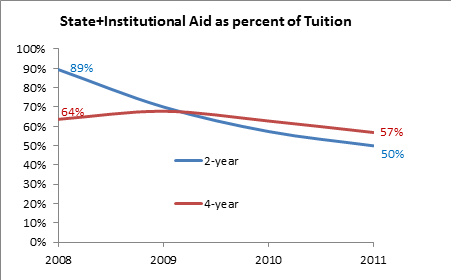
 
Aid at both 2 and 4 year colleges has fallen with aid at community colleges falling more than 4-year colleges.
This is just the tip of the iceberg.  In the first of CCLP’s “Opportunity Costs” Series we will investigate the overall consequences of higher education cuts across Colorado by addressing the following questions:
·         How sensitive are Colorado students to tuition prices?
·         How does the new model of financing higher education work out for different types of colleges?
·         What’s happened with overall student debt for Colorado students?
·         How has the recent recession impacted college attendance? 
While many of these questions have been addressed before, what makes our upcoming report especially unique is by answering:
·         How has this new higher education financing model influenced enrollment, broken down by sex, race, and income level?  

Thursday, September 6, 2012

The Football Stadium Economy

 
By Christopher Stiffler
As week one of the NFL season begins, the hype surrounding the Broncos opening match up with the Pittsburgh Steelers on Sunday Night Football continues to build.  Bronco and Steeler fans have substantially bid up the price of tickets.  With a limited amount of seats available in Sports Authority Field at Mile High, every Steeler fan who purchases a ticket for opening day directly translates into one less available ticket for a Broncos fan.  It makes sense to reason that if we remove all the Steeler fans from the crowd, more seats will be available for the blue and orange faithful.  
We often witness the same type of reasoning in the immigration debate.  If all undocumented immigrants are removed from the job market, it creates more availability for American citizens to fill those jobs.  Those who advocate removing undocumented immigrants so more Coloradans can find work, tend to view the economy as a sports arena that has a limited number of seats.  They also often display the same hostility toward undocumented workers as they display to Steeler fans taking their seats. 
However, unlike Steeler fans at Mile High, whose presence directly means fewer Bronco fans at the game, allowing immigrants into the Colorado economy does not mean fewer jobs for Colorado citizens.  In fact, it often means more.  A football stadium has a limited number of seats, whereas the economy is dynamic.  It expands and contracts; sometimes it needs fewer jobs sometimes it needs more.  There is not a fixed number of jobs in the state of Colorado, which is the part that the anti-immigration advocates tend to forget.  Undocumented immigrants’ unique labor market skills enable the economy to be more productive.  In addition, undocumented immigrants’ spending adds to aggregate demand. 
Once we get past the rhetoric and look at the reality of the modern economy, we can see the positive impact immigrants have on our economy.  This is because immigrants are often a complement to existing labor and not a direct substitute.  Immigration encourages the specialization of non-immigrant workers.  Undocumented labor encourages other, less-educated workers to leave physically intensive occupations for jobs that require language skills.  Productivity gains arise from specialization along with higher compensation paid for communication skills. 
Though it is not initially intuitive, rising education levels of the non-immigrant adult population have corresponded with increased immigration.  This is because immigrants have occupied many low-income jobs which move the non-immigrants into middle-income jobs.  Many economists agree that the key to a thriving and developing economy is constantly increasing productivity.  This means workers making the most of their individual skills.  If you accept the notion that our economy works well when everyone is maximizing their unique skills, then you must acknowledge that immigration has a positive impact on our economy.   
It is largely acknowledged that the immigration system in America has some major faults as a majority of Americans believe that Congress needs to reform immigration policy.  But while there has been very little improvement to immigration policy on the federal level, local and state governments face an increasing burden of finding, arresting, and detaining undocumented immigrants. 
While focusing only on enforcement strategies that involve deportation and strict immigration requirements, policy makers must be aware of the potential economic fallout from the disruptions, dislocations, and disturbances as immigrants’ absences ripple through the economy.  Removing undocumented workers won’t free up jobs for other workers, instead it will remove a complementary piece of the labor force that allows our economy to be dynamic. 
When Steeler fans are sprinkled around Mile High Stadium, it creates a louder, more energetic environment because Broncos fans are spurred to cheer longer and louder to drown out the Steeler cheers.  Our labor force functions the same way.  Undocumented immigrants in our labor force create a more vitalized, productive labor force for everyone. 

Christopher Stiffler is a Pennsylvania native turned Coloradan, and unfortunately, a lifelong Steelers fan.