Financial Aid Cuts and Consequences
By
Christopher Stiffler
One of the most memorable topics discussed in
Economics 101 is the idea of opportunity
cost. With a limited amount of
resources, a decision to do one activity inevitably results the inability to do
another. Economists calculate
opportunity cost by asking the question, “what is the value of the next best
alternative that you give up in order to do that activity?”
Pose the question, “what is the opportunity
cost of attending this lecture?” to a bunch of freshmen Economics 101 students
at 8 a.m. and the first response is always “sleeping.”
Pose the question, “what is the opportunity cost
of this new cut back in spending?” to a politician and it is difficult to get a
straight answer. This is because the
indirect and foregone alternatives are very difficult to quantify. But like all decisions, there is always an
opportunity cost; always a relationship between scarcity and choice. Cuts to state funding at one end inevitably
result in trade-offs somewhere else.
As Colorado has been cutting state funding to all
sorts of programs, it has been difficult to quantify the indirect, downstream
consequences. The Colorado Center on Law
and Policy’s goal with our “Opportunity Cost” series is to enumerate exactly what
Colorado forgoes as it chooses to be a low-funding state.
The first of this series investigates the
state cuts to higher education. Due
to budget balancing and reduced General Fund revenues, Colorado higher
education has seen a 30 percent operating cut since 2009. This means fewer dollars sent directly to
Colorado institutions and fewer dollars available for Colorado students in the
form of state financial aid. To
compensate for lower state funding, Colorado colleges and universities were
granted the ability to raise tuition. As
a result, a new college tuition model began to emerge. In the new model, wealthier students pay the
higher tuition, which is then redistributed in the form of institutional aid to
lower income students.
Recent research about price sensitivity of Colorado college
students shows that low-income students are much more sensitive to tuition
increases than higher-income folk. In fact, among wealthier students, higher
tuition correlates with higher enrollment while higher tuition correlates with
lower enrollment in lower-income students.
Given that many low-income students will forego college
without some form of financial aid, providing institutional financial aid to
low-income students is paramount to replacing the state financial aid that has
been cut over the past 5 years.
The first graph shows average state aid per student and average institutional
aid per student at 4-year institutions in Colorado. State aid per pupil has fallen 40 percent
since 2007 while institutional aid has risen at about the same pace. This indicates that institutional aid has
filled the gap left by declining state financial aid.
However, this is not the whole story. While 4-year universities have been able to
increase tuition and provide additional institutional aid to low-income
students, community colleges have not been as fortunate. When we look at the same figures for 2-year institutions instead of 4-year, a
completely different story emerges.
For 2-year colleges, average state aid has declined 46
percent since 2007 while institutional aid has remained fairly constant. In the
case of 2-year colleges, institutional aid has not filled the gap left by lower
state aid.
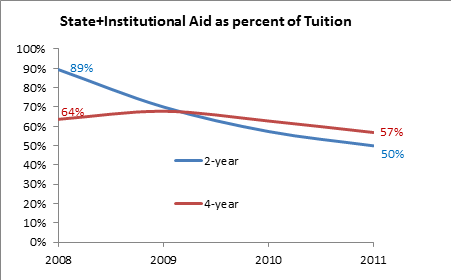
A more telling look at financial aid for low-income
Coloradans comes when state and institutional aid is plotted as a percent of
tuition.
Aid at both 2 and 4 year
colleges has fallen with aid at community colleges falling more than 4-year
colleges.
This is just the tip of the iceberg. In the first of CCLP’s “Opportunity Costs”
Series we will investigate the overall consequences of higher education cuts
across Colorado by addressing the following questions:
·
How sensitive are Colorado students to tuition
prices?
·
How does the new model of financing higher
education work out for different types of colleges?
·
What’s happened with overall student debt for
Colorado students?
·
How has the recent recession impacted college
attendance?
While many of these questions have been addressed before,
what makes our upcoming report especially unique is by answering:
·
How has this new higher education financing
model influenced enrollment, broken down by sex, race, and income level?



 Posts


